
Field note

Fine-tuning is engineering with probabilistic outcomes

The vendor demo makes fine-tuning look like installing software - upload data, train, deploy. The real distribution of outcomes is brutal, most of the work is data preparation, and the model you trained for wire fraud can quietly forget how to read ACH. For financial services, guessing is not an option.

Oct 6, 2025 · Navin Agrawal · Payments · 3 min read

Fine-tuning is engineering with probabilistic outcomes

Visual brief

Visual brief

Fine-tuning is engineering with probabilistic outcomes

As of October 2025

Fine-tuning demos for fraud detection look flawless - upload transaction data, train, ship. Then you run the actual numbers, and the gap between the demo and a model that meaningfully improves in production is enormous.

The instructor’s framing from hands-on training puts it bluntly: for every text-model fine-tune that genuinely helps, thousands of attempts produce no useful change or actively degrade the model. Visual models fare better, but the lesson holds - this is closer to a lab experiment than a software install.

Where the time actually goes is the first surprise. Roughly 80 percent of fine-tuning effort is data preparation - cleaning transaction logs, formatting compliance documents, removing bad examples, labeling edge cases - and only a sliver is running the training code. The easiest part of the job is the part the demos show.
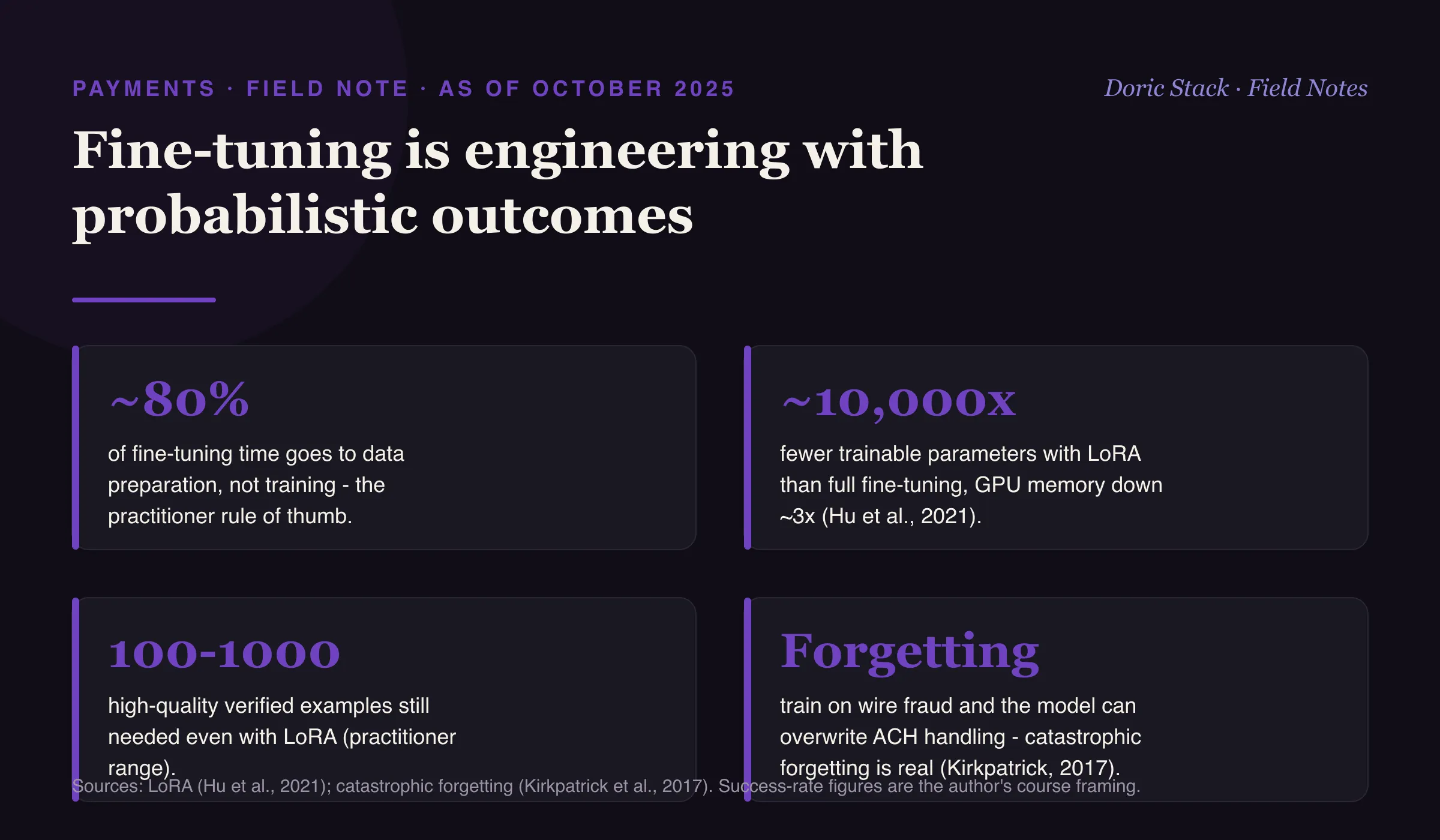
Fine-tuning is engineering with probabilistic outcomes (as of October 2025): roughly 80 percent of fine-tuning time goes to data preparation rather than training; LoRA cuts trainable parameters by up to about 10,000x versus full fine-tuning and GPU memory by about 3x (Hu et al., 2021); you still need 100 to 1,000 high-quality verified examples even with LoRA; and catastrophic forgetting is real, so a model trained on wire fraud can overwrite how it handles ACH (Kirkpatrick et al., 2017).
The training code is the cheap part. Knowing what to train on, and whether it worked, is the job.

The training code is the cheap part. Knowing what to train on, and whether it worked, is the job.

The training code is the cheap part. Knowing what to train on, and whether it worked, is the job.

Fine-tuning is engineering with probabilistic outcomes (as of October 2025): roughly 80 percent of fine-tuning time goes to data preparation rather than training; LoRA cuts trainable parameters by up to about 10,000x versus full fine-tuning and GPU memory by about 3x (Hu et al., 2021); you still need 100 to 1,000 high-quality verified examples even with LoRA; and catastrophic forgetting is real, so a model trained on wire fraud can overwrite how it handles ACH (Kirkpatrick et al., 2017).

Data prep

~80%

of fine-tuning time goes to data preparation, not training - the practitioner rule of thumb.

LoRA

~10,000x

fewer trainable parameters than full fine-tuning, with GPU memory down about 3x (Hu et al., 2021).

Examples

100-1000

high-quality, verified examples you still need even with LoRA (practitioner range).

The cheap part

Running the training code. That is the step the vendor demo shows, and it is the least of the work.

The expensive part

Knowing what to train on and whether it worked. Catastrophic forgetting is real - train a model to spot wire-fraud patterns and it can overwrite how it handles ACH, because fine-tuning overwrites rather than adds (Kirkpatrick et al., 2017). LoRA cuts the trainable parameters by orders of magnitude, but you still need 100 to 1,000 curated examples with verified outcomes. Real projects run three months and hundreds of experiments, and you only learn retrospectively which checkpoint actually worked.
Was this useful?

Choose once.

Related Posts

View All Posts »
Cross-border instant payments reintroduce the intermediary into the design

Cross-border instant payments reintroduce the intermediary into the design

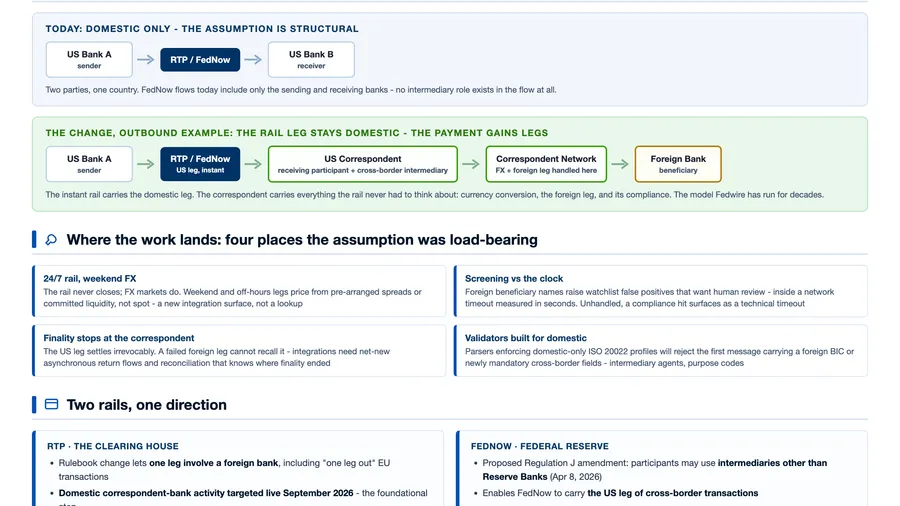
Federal Reserve and RTP rule changes opened a path for an instant-payment leg to involve intermediaries or foreign banks. The customer experience may look direct, but FX, sanctions review, settlement finality, message validation, and returns bring correspondent functions back into the architecture.

Agentic commerce has protocols before it has shared liability

Agentic commerce has protocols before it has shared liability

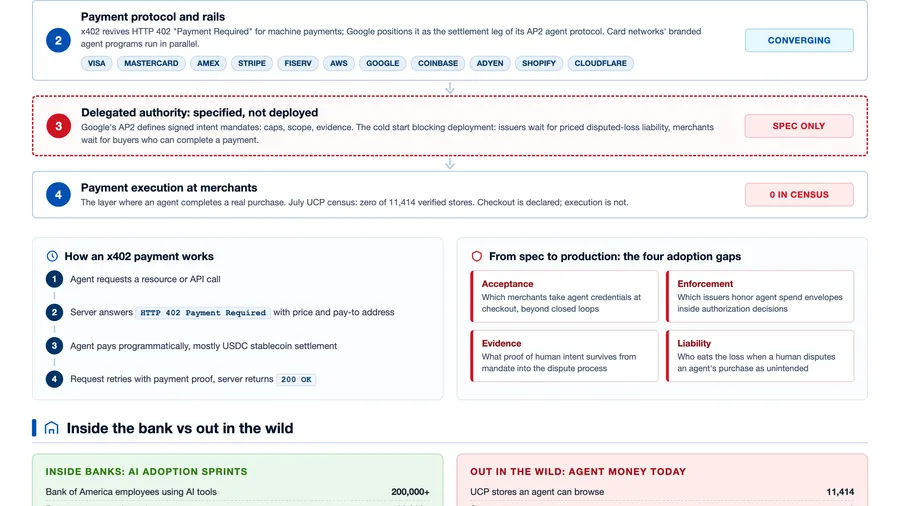
The x402 Foundation brought payment networks, processors, cloud firms, and crypto infrastructure into one standards effort in July 2026. Protocol agreement can describe a machine payment. Production acceptance still depends on issuers, merchants, and dispute operators honoring the same delegated authority.

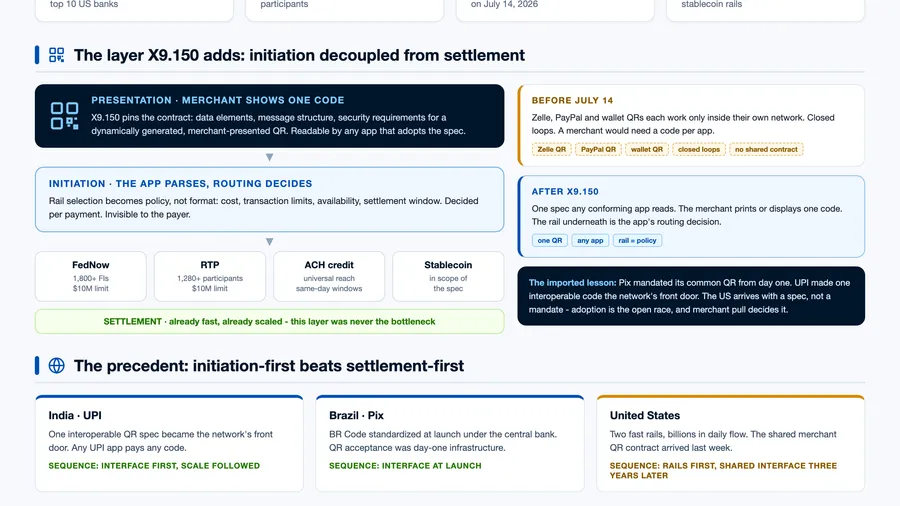
X9.150 separates the checkout contract from the payment rail

X9.150 separates the checkout contract from the payment rail

The United States built instant rails before it built an interoperable merchant-presented QR contract. X9.150 supplies that missing initiation layer, allowing the code at checkout to remain stable while routing policy chooses FedNow, RTP, ACH credit, or another supported rail.