
Field note

Fraud policy creates two different payment architectures: refund or hold

The United Kingdom places reimbursement duties on payment firms after qualifying APP scams. A July 2026 US House framework emphasized prevention, information sharing, and time to interrupt suspicious funds. One model repairs loss. The other tries to contain it before withdrawal.

Jul 27, 2026 · Navin Agrawal · Payments · 2 min read

Fraud policy creates two different payment architectures: refund or hold

Visual brief

Visual brief

Fraud policy creates two different payment architectures: refund or hold

As of July 2026

Refund and hold policies may share the same fraud signals, but they create different systems. One pays after loss. The other needs enough time and authority to contain money before it leaves the receiving institution.

Policy becomes executable through state, clocks, evidence, and ownership. The legal choice determines the payment architecture.

UK control

Reimburse

qualifying APP scam claims create duties for sending and receiving payment firms.

US direction

Interrupt

the July 2026 House framework emphasized prevention, data sharing, and stopping funds.

Architecture

Stateful hold

suspicion, decision time, release, escalation, and evidence become explicit states.

Reimbursement builds a post-loss operating path

The UK reimbursement model requires intake, eligibility checks, allocation between firms, customer communication, payment, and recovery work. Sending institutions need confirmation-of-payee and scam controls before release. Receiving institutions need mule-account detection and evidence that can support the reimbursement decision after the payment has settled.

Holds build an in-flight decision path

A hold model needs a different state machine. Funds can arrive without becoming available. A suspicion trigger starts a clock. Investigators need a lawful evidence path, release and escalation rules, customer notices, and an auditable reason for every decision. The payment can settle while availability remains suspended.
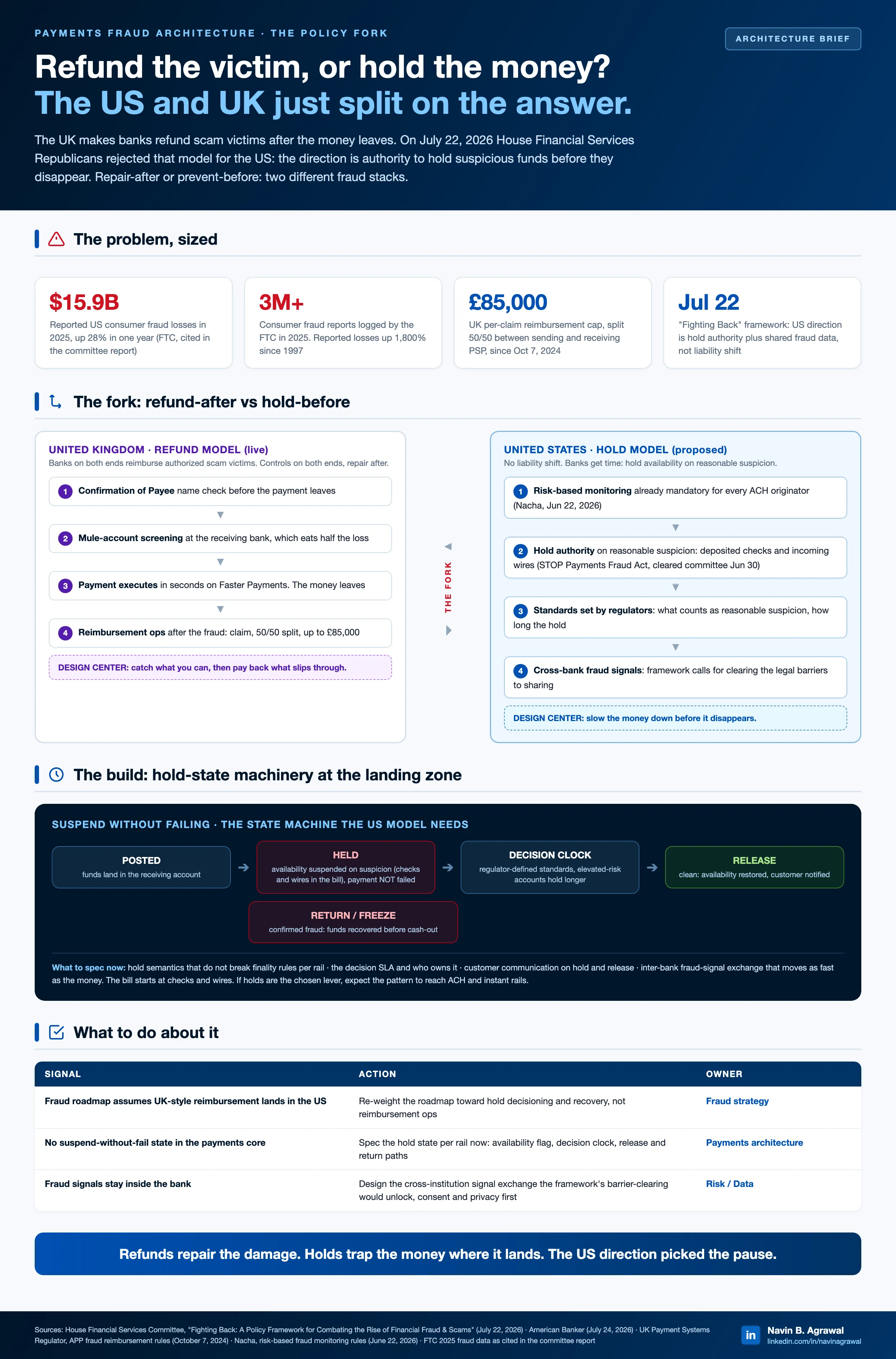
Comparison of UK reimbursement and US hold-oriented fraud controls, including sending-bank checks, receiving-bank mule detection, a bounded hold state, release decisions, and post-loss reimbursement operations.
Refund allocates loss after settlement. Hold architecture tries to preserve recovery value before withdrawal.

Refund allocates loss after settlement. Hold architecture tries to preserve recovery value before withdrawal.

Refund allocates loss after settlement. Hold architecture tries to preserve recovery value before withdrawal.

Comparison of UK reimbursement and US hold-oriented fraud controls, including sending-bank checks, receiving-bank mule detection, a bounded hold state, release decisions, and post-loss reimbursement operations.

The shared dependency is cross-bank signal speed

Neither model works inside one institution. The sending bank sees the customer interaction and authorization pattern. The receiving bank sees account age, inbound concentration, rapid dispersal, and mule indicators. A hold isn’t useful unless the receiving institution receives a credible signal before the funds move again. Reimbursement is fair only if both sides can exchange evidence without turning each claim into a manual document chase.

That makes the event fabric a first-class payment component. The signal needs a common identifier, a reason code, confidence, timestamps, ownership, retention rules, and a closed-loop outcome. Fraud teams can then measure which signals prevented loss, which caused unnecessary holds, and where release decisions missed their clock.

A refund policy allocates the loss. A hold policy buys time. Both fail when the fraud signal arrives after the money has moved again.
Was this useful?

Choose once.

Related Posts

View All Posts »
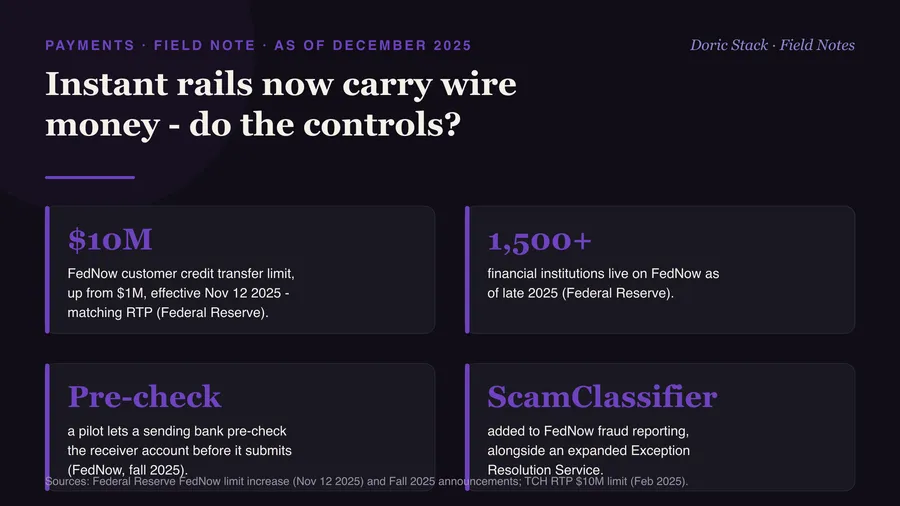
Instant rails now carry wire money. Do the controls?

Instant rails now carry wire money. Do the controls?

FedNow matched RTP at a $10M network limit in November 2025 and added new risk rails - a receiver-account pre-check pilot, ScamClassifier reporting, an Exception Resolution Service, and 1,500+ banks live. Instant is treasury cash now, and batch-era controls just got a 24/7 bypass.

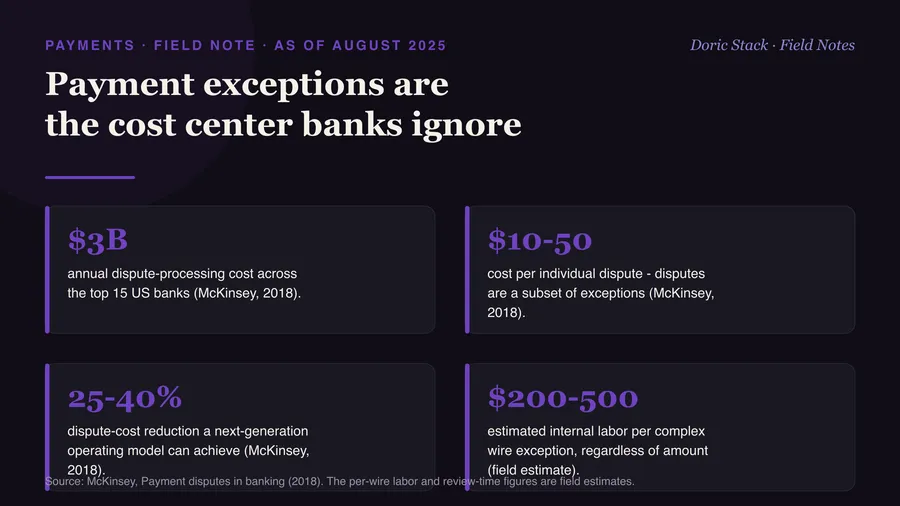
Banks count fraud dollars and miss the exception bill

Banks count fraud dollars and miss the exception bill

Every failed payment kicks off a chain of manual work that rarely shows up in a fraud dashboard. Across the top 15 US banks, dispute processing alone runs about $3 billion a year - and the wire flagged at $50K costs the same to investigate whether it is real or not.

Cross-border instant payments reintroduce the intermediary into the design

Cross-border instant payments reintroduce the intermediary into the design

Federal Reserve and RTP rule changes opened a path for an instant-payment leg to involve intermediaries or foreign banks. The customer experience may look direct, but FX, sanctions review, settlement finality, message validation, and returns bring correspondent functions back into the architecture.

Agentic commerce has protocols before it has shared liability

Agentic commerce has protocols before it has shared liability

The x402 Foundation brought payment networks, processors, cloud firms, and crypto infrastructure into one standards effort in July 2026. Protocol agreement can describe a machine payment. Production acceptance still depends on issuers, merchants, and dispute operators honoring the same delegated authority.