
Field note

Banks are starting to twin the org, not just the branch

Digital twins began as 3D models of physical space. The next step is simulating how a bank actually runs - so you can test a payment-rail change or a regulatory shift against every system before it touches production. Most banks still only document what exists.

Sep 8, 2025 · Navin Agrawal · Payments · 3 min read

Banks are starting to twin the org, not just the branch

Visual brief

Visual brief

Banks are starting to twin the org, not just the branch

As of September 2025

Traditional enterprise architecture documents what exists. An organizational digital twin predicts what happens when you change it - which is a different thing entirely, and the more useful one.

The shift showed up in an acquisition: in January 2025 Accenture bought Percipient’s Digital TWINN platform, moving the idea from twinning physical spaces to simulating how an organization actually operates. The branch-scanning version was already paying off, but it was the warm-up.

Banking adoption

71%

of banking and financial firms already use digital-twin technology (Altair survey, 2023).

Branch twinning

$500K

BMO's savings from digital-twinning 503 branches in the Bank of the West deal (Matterport, 2024).

Digital core

Up to 60%

higher revenue growth for firms with an advanced digital core, across 19 industries (Accenture, 2024).
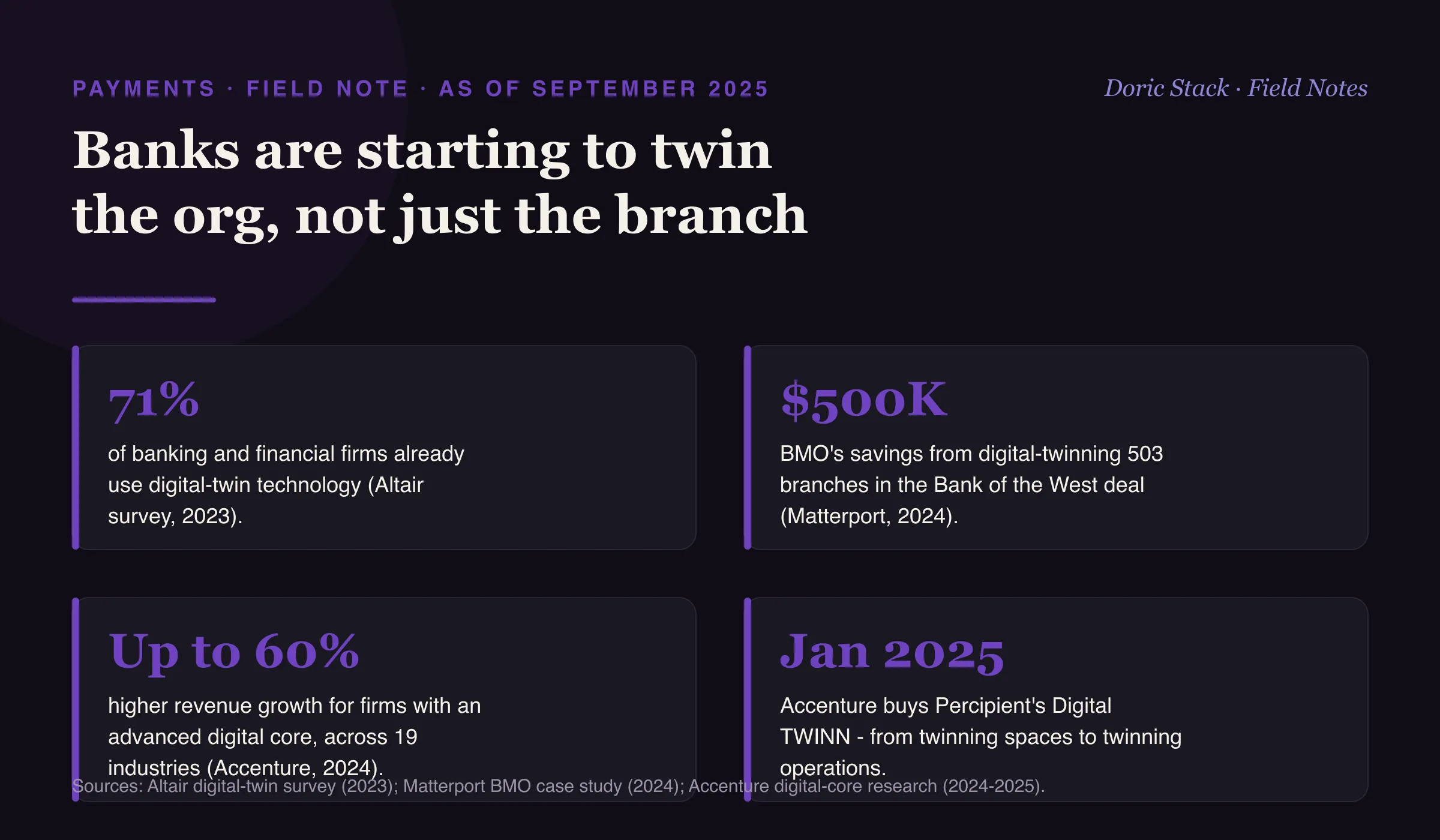
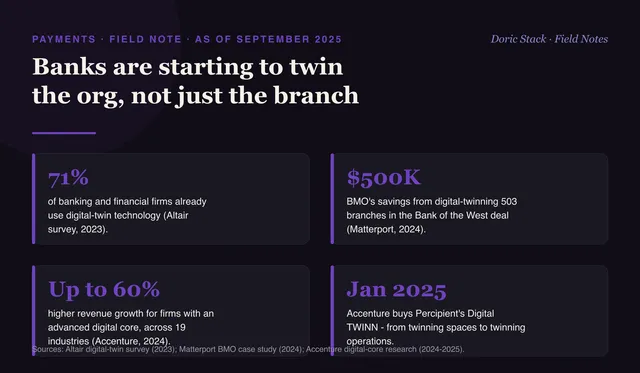
Banks are starting to twin the org, not just the branch (as of September 2025): 71 percent of banking and financial firms already use digital-twin technology (Altair survey, 2023); BMO saved about $500,000 by digital-twinning 503 branches during the Bank of the West acquisition (Matterport, 2024); firms with an advanced digital core see up to 60 percent higher revenue growth across 19 industries (Accenture, 2024); and in January 2025 Accenture acquired Percipient's Digital TWINN platform, moving from twinning spaces to twinning operations.
From scanning a branch in 3D to simulating the whole institution before you change it.

From scanning a branch in 3D to simulating the whole institution before you change it.

From scanning a branch in 3D to simulating the whole institution before you change it.

Banks are starting to twin the org, not just the branch (as of September 2025): 71 percent of banking and financial firms already use digital-twin technology (Altair survey, 2023); BMO saved about $500,000 by digital-twinning 503 branches during the Bank of the West acquisition (Matterport, 2024); firms with an advanced digital core see up to 60 percent higher revenue growth across 19 industries (Accenture, 2024); and in January 2025 Accenture acquired Percipient's Digital TWINN platform, moving from twinning spaces to twinning operations.

Adoption is already broad. An Altair survey in 2023 found 71 percent of banking and financial firms using digital-twin technology, most often for business-process optimization, real-time behavioral monitoring, and predictive analytics. The physical-space version has a clean payback too: BMO saved roughly $500,000 by twinning 503 branches during the Bank of the West acquisition.

Document versus simulate

A model of what exists tells you the current state. A twin of how the organization behaves tells you the next state.

What simulation changes

Instead of testing a payment-rail change in production, you simulate it. Instead of hoping a regulatory change does not break operations, you model the impact across every system at once. Instead of reacting to a cascade failure, you watch it form in the twin first. Accenture’s 2024 research across 19 industries put firms with an advanced digital core at up to 60 percent higher revenue growth and 40 percent higher profit, though getting there takes executive sponsorship and real data integration into decades-old cores.
Was this useful?

Choose once.

Related Posts

View All Posts »
Payment modernization stalls at security review, not architecture

Payment modernization stalls at security review, not architecture

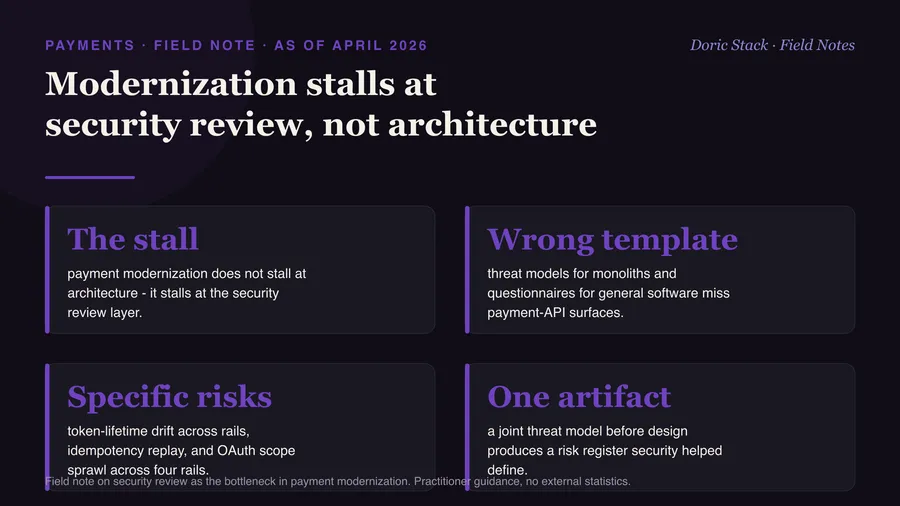
Payment modernization projects do not stall at the architecture layer. They stall at the security review layer - threat models built for monoliths, questionnaires written for general software, cycles tuned for annual releases. The teams that ship on time put security in the room before design, not after.

A chartered bank just put a stablecoin on card settlement

A chartered bank just put a stablecoin on card settlement

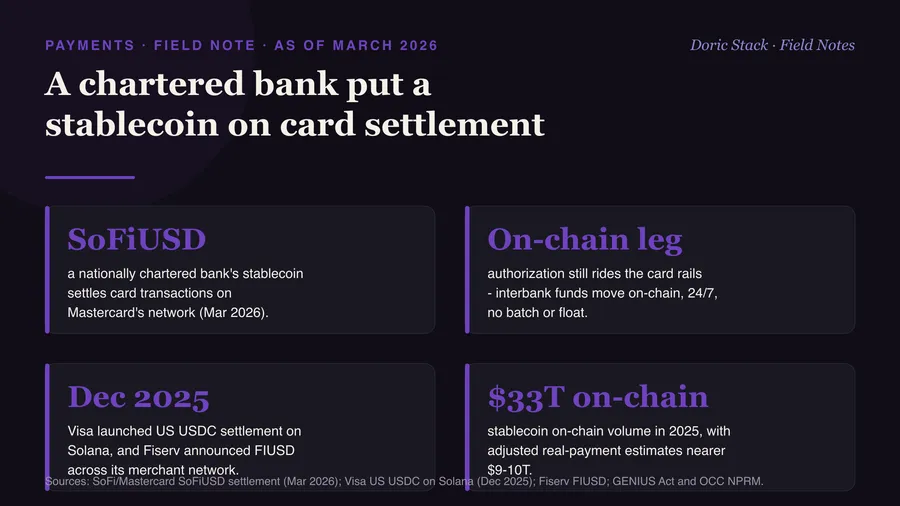
SoFi Bank put SoFiUSD on Mastercard's settlement layer. Authorization still rides the card rails and the merchant sees nothing change, but the interbank fund movement happens on-chain, around the clock, with no batch window and no correspondent float. For the first time, issuers and acquirers get to choose their settlement medium.

Banks count fraud dollars and miss the exception bill

Banks count fraud dollars and miss the exception bill

Every failed payment kicks off a chain of manual work that rarely shows up in a fraud dashboard. Across the top 15 US banks, dispute processing alone runs about $3 billion a year - and the wire flagged at $50K costs the same to investigate whether it is real or not.

Cross-border instant payments reintroduce the intermediary into the design

Cross-border instant payments reintroduce the intermediary into the design

Federal Reserve and RTP rule changes opened a path for an instant-payment leg to involve intermediaries or foreign banks. The customer experience may look direct, but FX, sanctions review, settlement finality, message validation, and returns bring correspondent functions back into the architecture.