
Field note

The agent tool layer inherited a local trust model on the public internet

A July 2026 study found hundreds of internet-facing MCP servers and a high rate of missing OAuth among the systems it tested. MCP began with local stdio trust. When teams exposed that model over HTTP, credentials, policy, and audit did not appear by default.

Aug 24, 2026 · Navin Agrawal · AI · 3 min read

The agent tool layer inherited a local trust model on the public internet

Visual brief

Visual brief

The agent tool layer inherited a local trust model on the public internet

As of August 2026

MCP did not begin as an unauthenticated internet service. It began as a local protocol where stdio processes inherited trust from one machine. The exposure appeared when that trust model moved to HTTP without an equivalent identity boundary.

The fix needs defense at the gateway and at each server. A gateway that can be bypassed is routing, not enforcement.

Confirmed servers

640

the July study identified production MCP servers exposed on the public internet.

Dynamic sample

414

the researchers tested this subset rather than treating every discovered endpoint as equivalent.

No OAuth

91.8%

the reported rate applies to the dynamically audited sample, not all discovered servers.

Local trust traveled farther than intended

The MCP specification treats authorization as optional and distinguishes HTTP from stdio. A local stdio server can use environment-provided credentials inside an existing process boundary. Put the same server on a reachable HTTP endpoint and that inherited boundary disappears. The tool may still execute with broad local privileges while the caller has no verified identity.

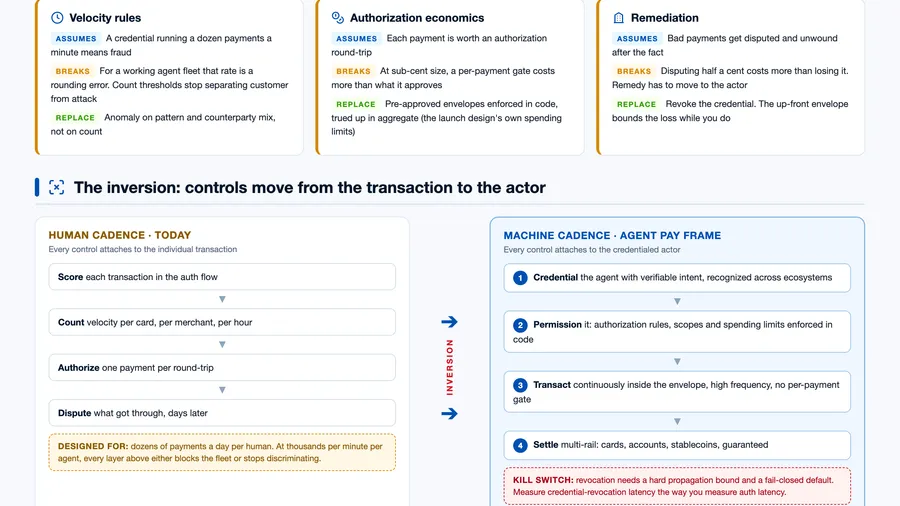
The payment analogy has two layers

Card systems hardened endpoints through EMV, injected keys, and point-to-point encryption. They also centralized routing, risk, and audit through acquirers and networks. Agent tools need the same split. Each server validates the caller and scope. A broker or gateway applies shared identity, policy, rate, routing, and audit controls across the fleet.
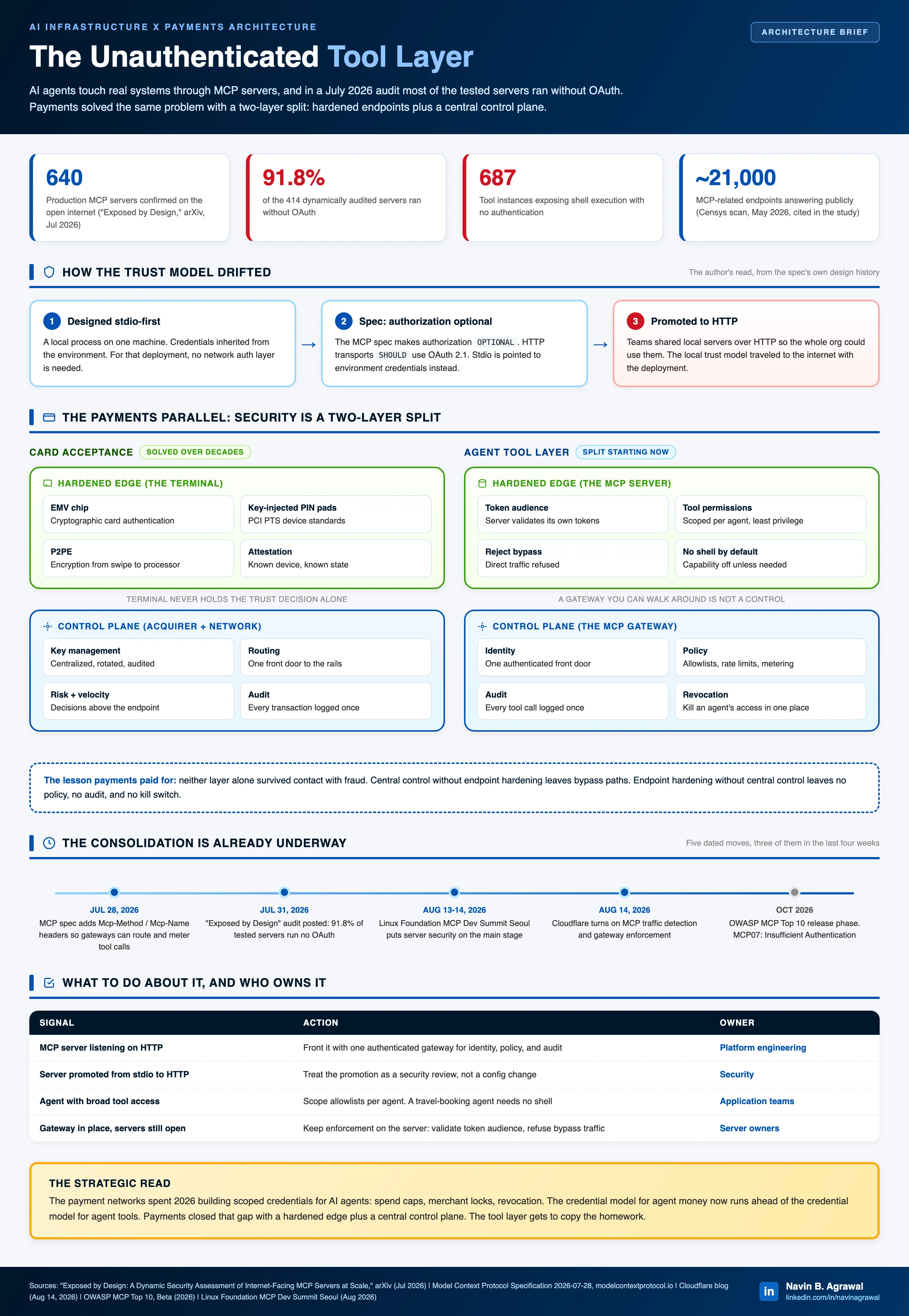
MCP security architecture showing the local stdio trust boundary, exposed HTTP servers, an identity and policy gateway, server-side token validation, scoped tool permissions, rate controls, and audit events.
Central policy reduces inconsistency. Server-side validation prevents the gateway from becoming a single bypass point.

Central policy reduces inconsistency. Server-side validation prevents the gateway from becoming a single bypass point.

Central policy reduces inconsistency. Server-side validation prevents the gateway from becoming a single bypass point.

MCP security architecture showing the local stdio trust boundary, exposed HTTP servers, an identity and policy gateway, server-side token validation, scoped tool permissions, rate controls, and audit events.

The gateway becomes useful when it knows the protocol

The July 2026 specification added protocol headers that can help gateways identify and route MCP traffic without parsing every body. Cloudflare’s August update showed the same direction through MCP traffic detection and enforcement. That is the start of a control plane, but detection alone doesn’t create identity or least privilege.

Every tool call needs an authenticated principal, server and method scope, policy decision, request identifier, outcome, and audit record. Shell and file tools need narrower execution identities than the host process. Secrets should stay in the server boundary and never travel through prompts or tool arguments. Network policy should prevent direct access that bypasses the broker.

The tool server validates authority. The gateway applies shared policy. Security fails when either side assumes the other one did both jobs.
Was this useful?

Choose once.

Related Posts

View All Posts »
Context rot can start before the first prompt

Context rot can start before the first prompt

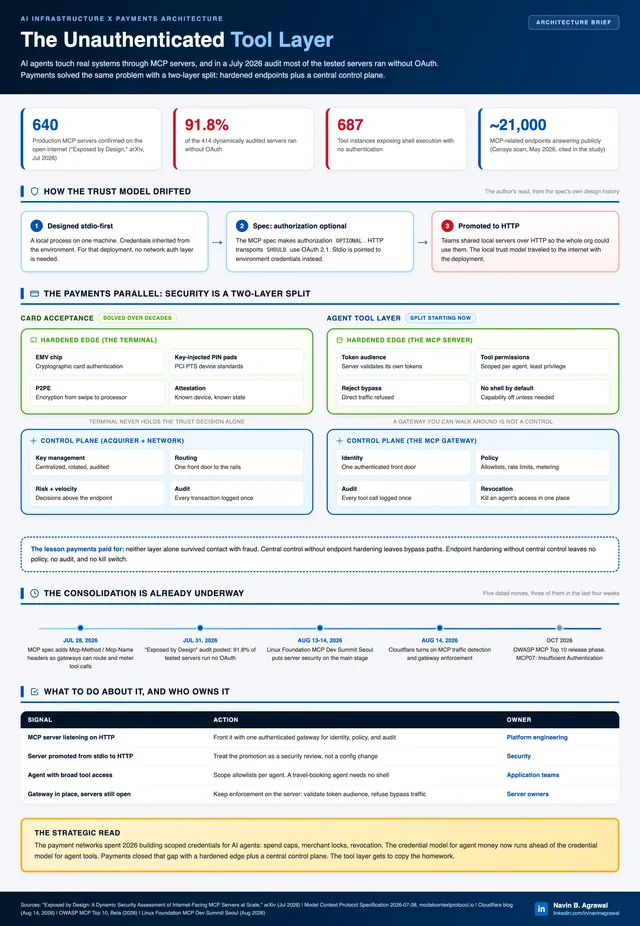
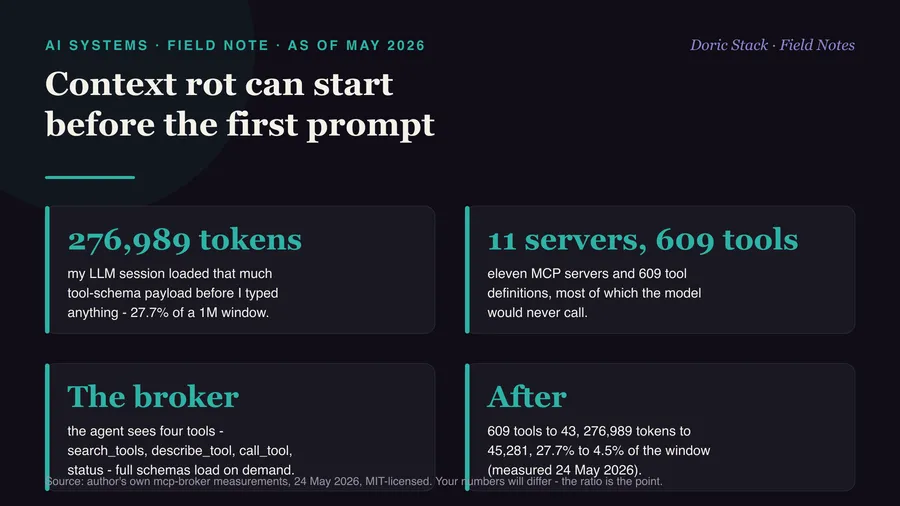
My LLM session loaded 276,989 tool-schema tokens before I typed anything - eleven MCP servers, 609 tool definitions, 27.7 percent of a million-token window spent on payload the model might never call. A bigger context window did not fix that, it gave the problem more room. So I built mcp-broker, PgBouncer for MCP, and the always-loaded tool payload dropped by more than 80 percent.

Payment modernization stalls at security review, not architecture

Payment modernization stalls at security review, not architecture

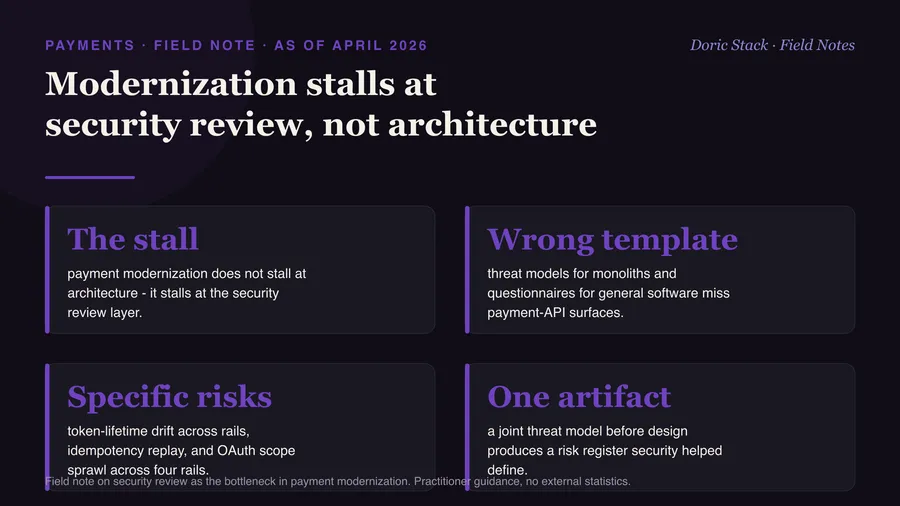
Payment modernization projects do not stall at the architecture layer. They stall at the security review layer - threat models built for monoliths, questionnaires written for general software, cycles tuned for annual releases. The teams that ship on time put security in the room before design, not after.

Payment APIs are having their USB-C moment with MCP

Payment APIs are having their USB-C moment with MCP

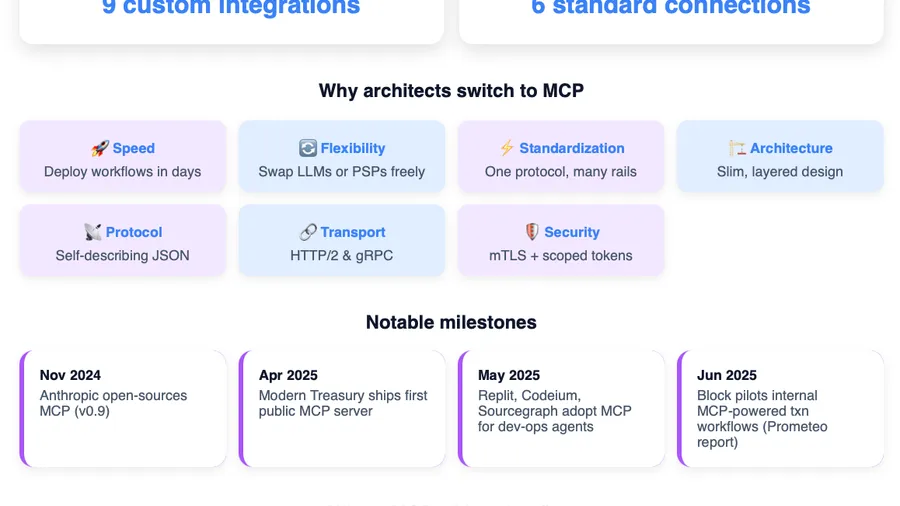
Most payment integrations still look like 2015 - custom code per platform, months-long builds. The Model Context Protocol turns MxN integrations into M+N, and payment platforms are starting to ship it. The promise is real; so are the enterprise security gaps.