
As of August 2026
The market is separating the payment instrument from finality. Customer tokens can compete on programmable networks while a central-bank asset closes the interbank obligation underneath.
Last July the BIS published a blueprint where central-bank reserves and tokenized deposits settle on one programmable platform. That was an architecture signal. In the last week of August 2026, three public institutions pushed the same pattern toward infrastructure design.
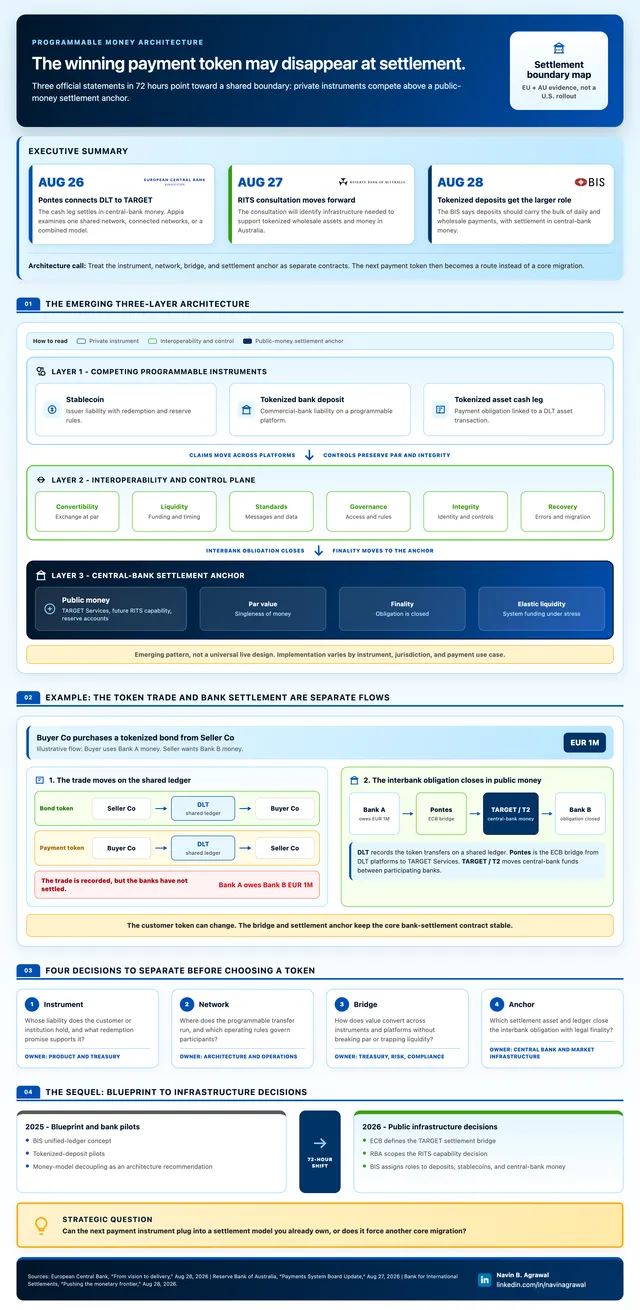
ECB, Aug 26
Pontes
will connect market DLT platforms to TARGET Services so the cash leg settles in central-bank money.
RBA, Aug 27
RITS
consultation backed on the infrastructure needed to support tokenized wholesale assets and money.
BIS, Aug 28
Deposits
tokenized deposits should carry the bulk of daily payments, anchored in central-bank money.
Instruments compete. Finality does not.
A customer may hold a stablecoin. A corporate may move a tokenized bank deposit. A securities platform may settle its cash leg on DLT. Those instruments can compete for the customer relationship while the interbank obligation closes in a central-bank asset that none of them issues. The week’s three statements each defend one piece of that split: the ECB is building the connection, the RBA is consulting on the plumbing, and the BIS is arguing for which instrument carries daily volume.
Why this reads as design, not commentary
Central banks rarely coordinate press cycles. When the connection project, the infrastructure consultation, and the instrument argument land in the same week and point at the same layering, the useful reading is that the layer boundary itself is stabilizing.
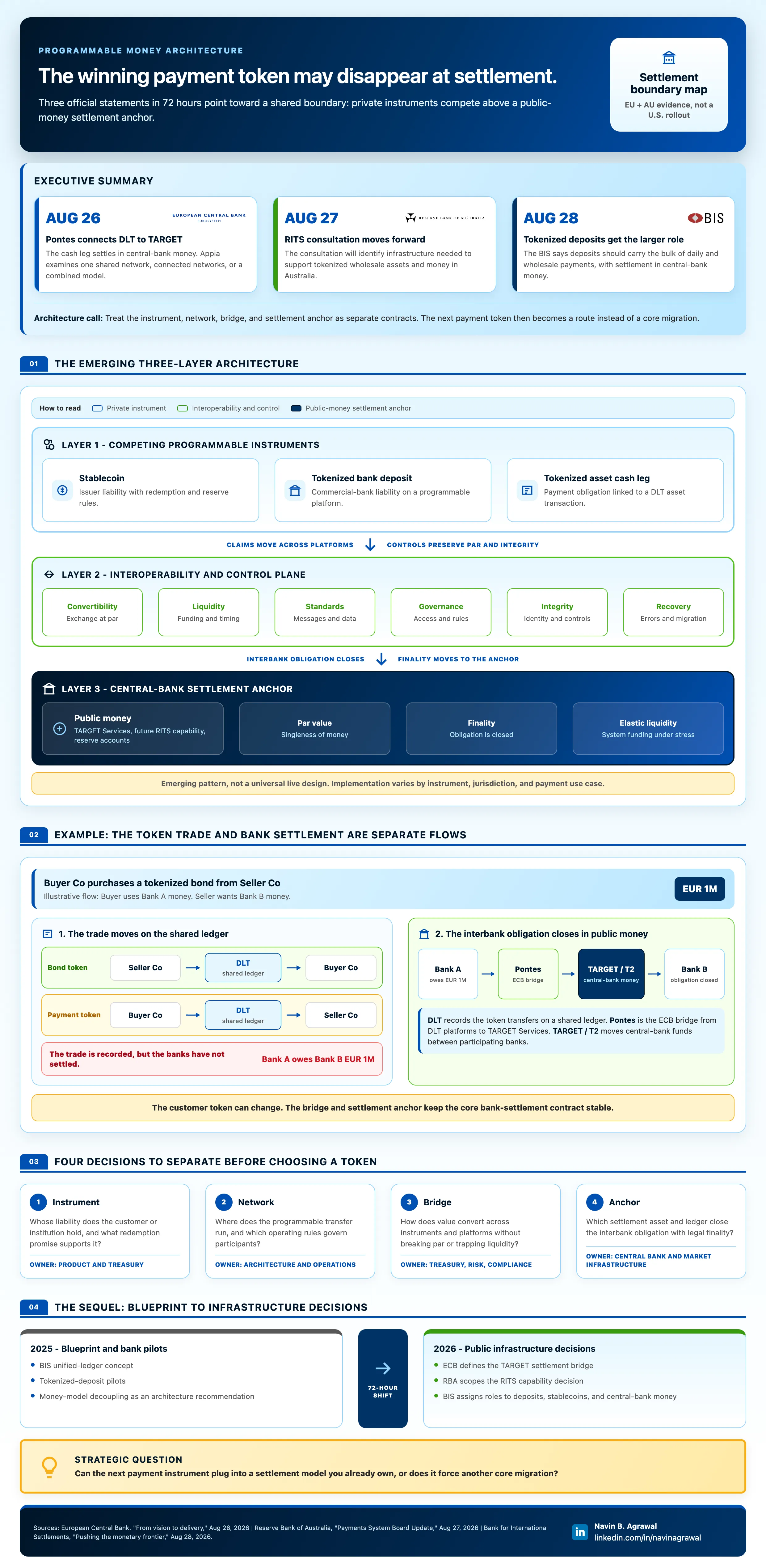
Instruments compete above the line. The anchor below the line makes settlement final. The EUR 1 million trade is an illustrative example, not an observed transaction.
Model four decisions separately
Platforms age badly when one rail owns all four of these choices, because every new instrument becomes a core migration.
- The instrument. Whose liability does the customer hold?
- The network. Where does the programmable transfer run?
- The bridge. How does value convert across instruments at par?
- The anchor. Which ledger makes settlement final?
Separate them and the next token becomes a route instead of a rewrite.
The stablecoin race may end by changing the bank-money stack more than replacing it.