
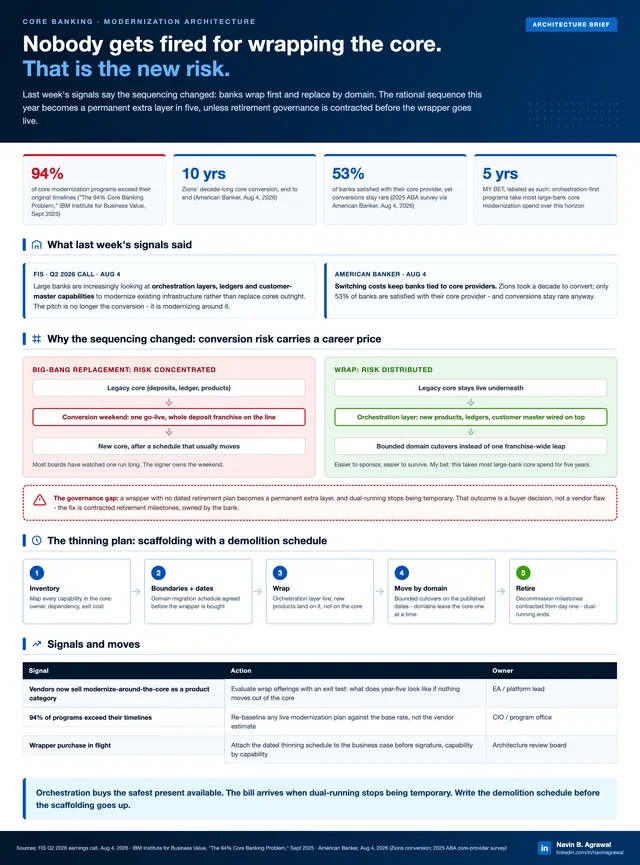
As of August 2026
Wrapping the core is a rational way to reduce cutover risk. It becomes an architecture failure when the wrapper gets a delivery plan and the displaced core capability gets no retirement plan.
The program needs two roadmaps from day one: construction for the new boundary and demolition for the old one.
Modernization signal
Wrap first
orchestration, ledgers, and customer-master capabilities move around the incumbent core.
Program risk
94%
IBM reported that most core modernization programs exceed their planned timelines.
Control
Retire by date
every duplicated core capability needs an owner, exit condition, and funded removal milestone.
Why wrap-first wins sponsorship
A full core conversion concentrates data migration, product behavior, posting, interfaces, customer servicing, and operational readiness into one risk event. A wrap-first sequence bounds the move. The bank can place orchestration, customer identity, product services, or a new ledger at a defined seam while the incumbent system continues to carry the rest.
Why wrappers become permanent
The new layer has a delivery team, budget, release date, and executive sponsor. Retirement work sits in the future and often loses all four. Dual-running then becomes an operating model. Data is reconciled twice, defects cross two ownership boundaries, and the wrapper accumulates exceptions for behavior that was never removed from the core.
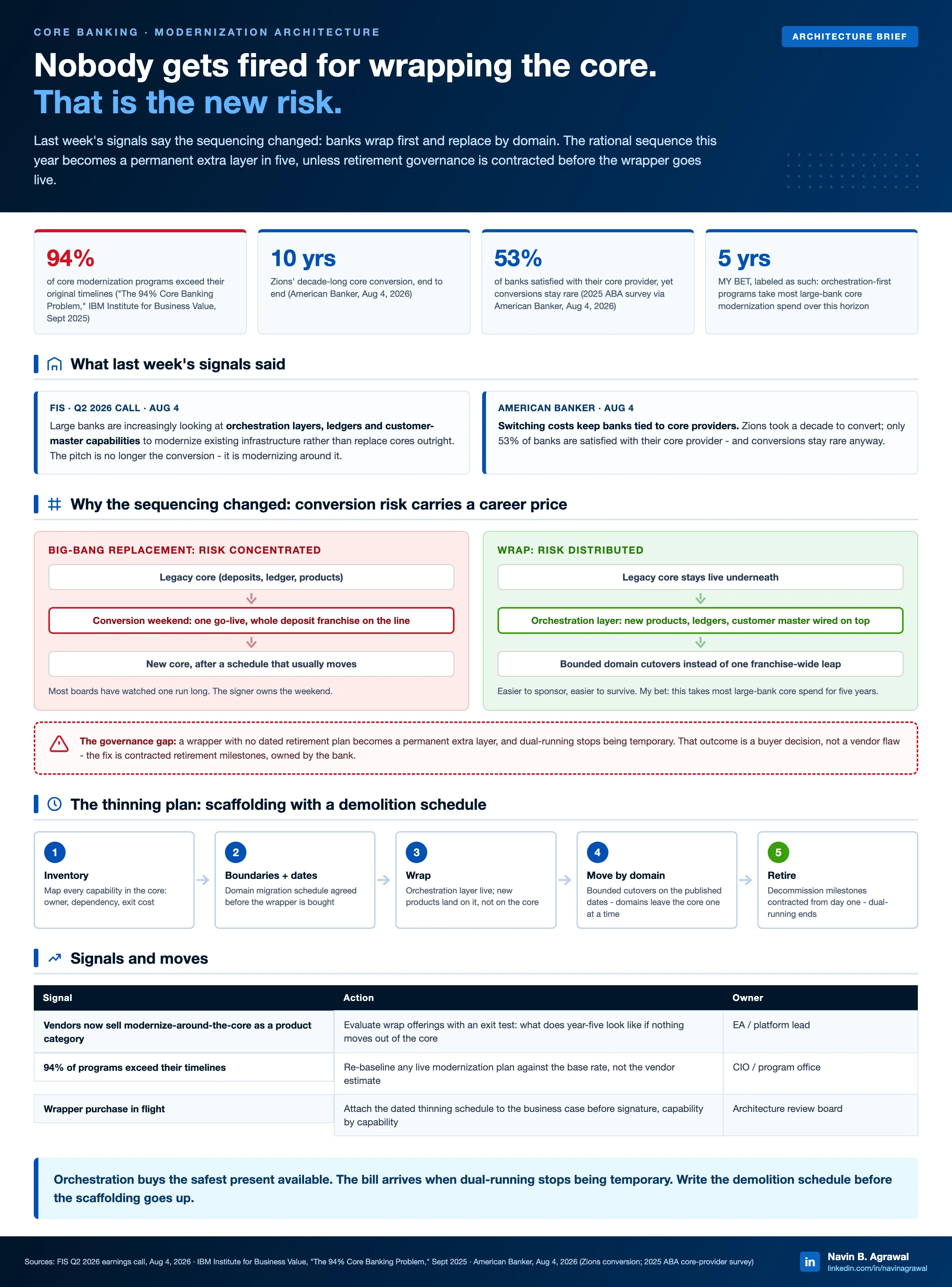
A wrapper is scaffolding only when the demolition milestones are funded and owned.
The demolition schedule is an architecture artifact
Each wrapped capability needs a current owner, target owner, authoritative data source, integration seam, migration cohort, exit test, and retirement date. The schedule should also state what happens when the date slips. Without that decision, every delay defaults to keeping both paths alive. If the old path doesn’t have an owner and a date, it stays.
This is where capability mapping earns its place. The map prevents teams from modernizing interfaces while leaving the same business rule active in two systems. It exposes which domains can move independently, which depend on a shared ledger or customer master, and which have no viable exit until a downstream consumer changes.
Wrap-first reduces the size of each move. Retirement governance decides whether those smaller moves ever add up to modernization.